
In our catalog — researched, not scored
Semi-Automatic
KRUPS Barista Espresso Machine
Semi-Automatic · Single · integrated grinder
Check price →
Check price on Amazon →Home › Guides › Coffee Maker with Grinder
☕ Buying Guide · 2026"Grind and brew" describes two quite different machines, and they suit almost opposite people. Here is the distinction, and the 13 machines in our catalog that have a grinder inside.
The best coffee maker with a grinder depends on whether you want manual control over espresso or one-touch convenience — because search for one and you get two categories mixed together: espresso machines with an integrated grinder, which grind and dose for you and then hand over control, and bean-to-cup machines, which do the whole drink at one touch. Both are "grind and brew". They suit almost opposite people.
"Grind and brew" is the trade's term for any machine that grinds whole beans and then brews from them without you moving the coffee in between. It is a description of the plumbing, not of a product category — which is precisely why the search results mix two very different machines together, and why the distinction below matters more than any single recommendation.
In this guide the term covers the espresso-oriented grind-and-brew machines in our catalog. Conventional drip coffee makers with a grinder built in are a separate category, and we do not cover them here.
| Espresso machine + integrated grinder | Bean-to-cup | |
|---|---|---|
| What it automates | Grinding and dosing | The entire drink, often including milk |
| What you do | Prepare the puck and control the extraction; the exact steps vary by machine | Press a button |
| Can you improve results? | Yes — grind, dose and timing are yours to adjust | Within the settings the machine exposes |
| Milk | Usually manual steaming; some models add assistance | Automatic on most models |
| Suits | Someone who wants to make espresso | Someone who wants espresso to appear |
Neither is better. They answer different questions, and the price overlap between them is what makes the category confusing — a well-specified semi-automatic and an entry bean-to-cup can cost the same and deliver completely different mornings.
Two appliances become one, which is genuinely valuable on a small counter and genuinely limiting later.
These grind and dose automatically, then leave the shot to you. They are the better route if you want to learn espresso by controlling the extraction yourself.
Choose this category if control over the shot matters more to you than one-touch convenience.
Choosing within it: these three differ mainly in entry price, how fast they reach temperature, and whether you prefer a dial or a screen. They are not three tiers of cup quality, which is why we have not ranked them.
Semi-Automatic · Single · integrated grinder

Semi-Automatic · ThermoCoil · integrated grinder
The all-in-one starter package: integrated conical burr grinder, ThermoCoil heating and a steam wand in one footprint, so you do not need a separate grinder to get started. The trade is the one the whole category makes — the grinder cannot be upgraded without replacing the machine.
Check price on Amazon →
Semi-Automatic · Single · integrated grinder
A compact semi-automatic with an integrated grinder and a built-in tamping lever instead of a loose tamp, which De'Longhi positions as making the dose-and-tamp step more repeatable while you are learning it.
Check price on Amazon →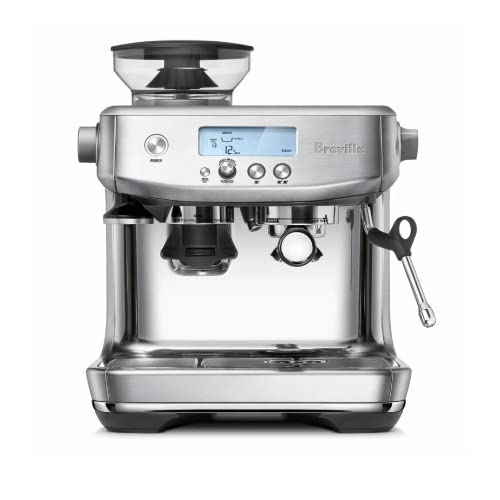
Semi-Automatic · ThermoJet · integrated grinder
A higher-end integrated-grinder option in Breville's Barista line, with ThermoJet heating and a digital interface in place of the Barista Express's ThermoCoil and dial. Breville states its ThermoJet system reaches extraction temperature in 3 seconds.
Check price on Amazon →These complete the drink themselves. Our Best Bean-to-Cup award covers this category on the full scored standard.
Choose this category if convenience and repeatability matter more to you than manual control.
Choosing within it: the money buys breadth of one-touch drinks, milk-system design and how much of the cleaning the machine does for you — not a categorically different espresso. Only the badged machine here has been scored.

Bean-to-Cup · Single Thermoblock · integrated grinder
A bean-to-cup machine built around the LatteGo milk system, which separates into parts you rinse rather than running milk through internal tubes. That is the practical argument for it: in a household making milk drinks daily, cleaning effort is often what decides whether a machine keeps getting used.
Check price on Amazon →
Bean-to-Cup · Single · integrated grinder

Bean-to-Cup · Single · integrated grinder

Bean-to-Cup · Single · integrated grinder

Bean-to-Cup · Single Thermoblock · integrated grinder
An entry-level bean-to-cup machine with an integrated grinder and automatic milk system. It automates the full drink with a narrower range of configurable specialities than the machines above it — a trade at this level rather than a defect.
Check price on Amazon →
Bean-to-Cup · Single · integrated grinder

Bean-to-Cup · Single Thermoblock · integrated grinder
A bean-to-cup machine positioned between De'Longhi's entry machines and the Jura range, with an integrated grinder and the LatteCrema automatic milk system. Its step up from the entry machines is the interface and the milk workflow rather than a different brewing category.
Check price on Amazon →
Bean-to-Cup · Dual Thermoblock · integrated grinder
Jura's mid-range bean-to-cup machine: dual thermoblock heating and one-touch espresso, lungo and milk drinks. It sits below the Z10 in Jura's own range, with a narrower speciality list.
Check price on Amazon →
Bean-to-Cup · Dual Thermoblock · integrated grinder
Jura's flagship super-automatic, with Jura's Cold Extraction Process and a servo-driven Product Recognising Grinder. Jura lists its one-touch specialities at 32–40 depending on variant.
Check price on Amazon →This list is generated from our catalog by the integrated-grinder specification, so it stays in step with the catalog automatically and cannot be quietly curated. Specifications and reference prices come from that catalog and the live Amazon feed. Our build gate rejects any numeric specification in a product verdict that is not backed by a field on that product's own catalog record, or quoted and attributed to the manufacturer — so a spec and a sentence about it cannot drift apart. Badged machines have completed a scored award; the rest are catalog entries that have not. Prices update live; the price on Amazon at purchase applies.
It is worth it for the freshness and the counter space, and it costs you flexibility. Ground coffee exposes much more surface area to air than whole beans, which accelerates the loss of volatile compounds, so grinding immediately before brewing minimises the time it spends ground, and one appliance can take less counter space than a separate machine and grinder. The trade-off is that the grinder and brewer are integrated into the same appliance, so a failure in either system can mean servicing the whole machine, and that one budget is buying two jobs — so at the same total spend, putting a larger share of the budget into a dedicated grinder can give you more grinder capability. That is reasoning from how the cost is divided, not a measurement we have taken.
For most people optimising the cup, no — and this is the central point of this page. One budget is buying two jobs, so at the same total spend a dedicated grinder receives a larger share of the money than a grinder built into a machine does. What an integrated machine buys you instead is counter space, one appliance to live with, and a shorter path from beans to drink. If your constraint is space or simplicity, integrate. If your constraint is what is in the cup and you have the room, keep them separate. That is reasoning about how cost is divided, not a measurement we have taken.
They automate different amounts. A semi-automatic with an integrated grinder grinds and doses for you, then you tamp and start the shot yourself — you keep control over the variables and can learn to improve the result. A bean-to-cup machine does the entire sequence at one touch, including milk on many models. Choose the first if you want to make espresso, the second if you want espresso to appear.
Most have a bypass or single-dose chute for exactly this, so you can use decaf or a different coffee without emptying the hopper. It is worth checking before you buy if you drink decaf in the evening, because the alternative is emptying and refilling the hopper each time.
Integrated grinders in espresso machines are generally capable of espresso by design — that is what they are there for — and the better ones publish fine adjustment ranges. What they rarely match is a good standalone grinder at the same money, because one budget is buying two jobs. If grind quality is your priority rather than counter space, putting a larger share of the same spend into a dedicated grinder can give you more grinder capability.
Integrating a grinder adds cost, so these machines start higher than comparable machines without one. Our catalog's grind-and-brew entries run from the mid hundreds to the low thousands. Above that band you are buying automation, milk systems and build rather than a fundamentally better shot.
Three terms appear across this site and they mean three different things:
| Term | What it means |
|---|---|
| In our catalog | A machine we track, with specifications researched and checked against manufacturer documentation rather than copied from retail listings. |
| Recommended catalog pick | An editorial recommendation drawn from that catalog. Researched, not scored, and not an award. |
| Award winner | Completed our full scored evaluation against a published rubric, with its scorecard and known limitations published alongside it. |
What we do not do: we do not physically test these machines, measure shot temperature or pressure, or measure the grind their integrated grinders produce. Product specifications and manufacturer-named technologies are taken from current manufacturer documentation and recorded on our catalog records; they are not findings from our own hands-on testing. Where this page describes what living with a machine is like, that is documented owner and reviewer experience, and it is a weaker class of evidence than a published specification — we keep the two separate rather than blending them into one confident voice. The one machine here that has been scored against a published rubric is our Best Bean-to-Cup winner, and that evaluation is evidence-based rather than hands-on — its methodology and its limits are published with it.
Why the grind-quality comparison is stated the way it is: where we say a separate grinder can give you more grinder capability at the same total spend, that follows from how the budget is divided between two jobs inside one appliance, not from measurements we have taken. It is reasoning from cost, and we would rather say so than imply a test.
Feedback on this page: Best Coffee Maker With Grinder 2026: Espresso & Bean-to-Cup
Thank you. Your note is filed against this page and will be read.